Product Description
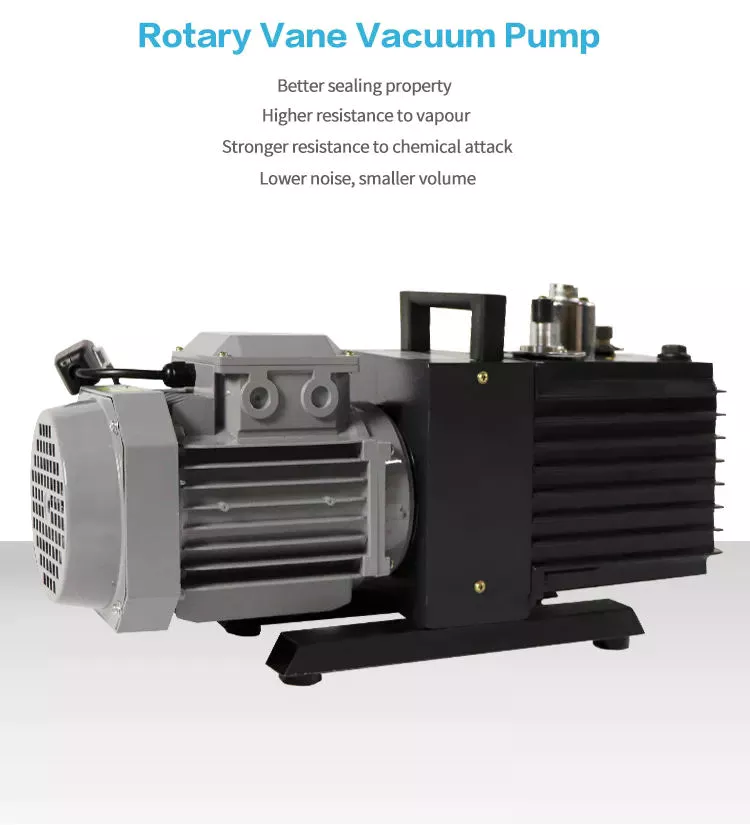
This oil sealed rotary vacuum pump is also been called as Oil-lubricated rotary vacuum pump, which is a positive-displacement pump that consists of vanes mounted to a rotor rotating inside of a circular casing.
The Strong water vapor extraction ability makes the rotary vane pump the best solution for CZPT drying, such as the flower CZPT drying, milk CZPT drying, meat CZPT drying, fruit CZPT drying, coffee CZPT drying and food CZPT drying, etc.
The evacuation chamber is filled with a specifically formulated mineral oil which acts as a sealant and lubricant between the vanes and vacuum pump chamber housing. It is the typical one-stage Rotary Vane Vacuum Pump which could also be widely used in various applications.
Features & Highlights
Rugged casing, made of High Purity Aluminum
Compact design to save installation spaces
High efficiency, benefits from the direct drive mechanism and compact structure
Pure copper motor and big air fans to make it run in long time without interruption
Quiet operation
Multi-rotating vanes and rubber pads are installed at the bottom, the operation is stable and the vibration is small
Easy install
German technology support
CE certification
Custom logo and color are accepted, CZPT even could provide laser caved logo or engraved logo on the pump body or shell
Available in stock for wholesale
| Model | BTV-040 | BTV-063 | BTV-100 | BTV-160 | BTV-200 | BTV-250 | BTV-300 | Remarks |
| Exhaust rate-50Hz (m³/h) | 40 | 63 | 100 | 160 | 200 | 250 | 300 | |
| Exhaust rate-60Hz (m³/h) | 48 | 75 | 120 | 192 | 240 | 300 | 360 | |
| Limiting pressure (mbar) | 0.1 | 0.1 | 0.1 | 0.1 | 0.1 | 0.1 | 0.1 | mbar(a)/Hg(V)/Torr |
| Power supply | 3-phase | 3-phase | 3-phase | 3-phase | 3-phase | 3-phase | 3-phase | |
| Motor power (kw) | 1.5 | 2.2 | 3 | 4 | 4 | 5.5 | 7.5 | |
| Working voltage(v) | 220-240 / 380-415 | 220-240 / 380-415 | 220-240 / 380-415 | 380-415 / 660-720 | 380-415 / 660-720 | 380-415 / 660-720 | 380-415 / 660-720 | |
| Motor speed-50HZ (r/min) | 1400 | 1400 | 1400 | 1400 | 1400 | 1400 | 1400 | |
| Motor speed-60HZ (r/min) | 1750 | 1750 | 1750 | 1750 | 1750 | 1750 | 1750 | |
| Noise(dB) | ≤63 | ≤68 | ≤72 | ≤74 | ≤76 | ≤76 | ≤76 | |
| Steam permissible pressure (mbar) | 40 | 40 | 40 | 40 | 40 | 40 | 40 | |
| Suction rate of steam (kg/h) | 0.3 | 0.3 | 0.6 | 1 | 1 | 1.6 | 2.5 | |
| Operating humidity (ºC) | 82 | 82 | 80 | 80 | 80 | 84 | 95 | |
| Operating Temperature (ºC) | 80 | 80 | 80 | 80 | 80 | 80 | 80 | |
| Ambient temperature (ºC) | 10~40 | 10~40 | 10~40 | 10~40 | 10~40 | 10~40 | 10~40 | |
| Oil capacity (L) | 1 | 2 | 2 | 5 | 5 | 6.5 | 6.5 | |
| Weight approx (kg) | 42 | 81 | 85 | 152 | 159 | 189 | 198 | |
| Type of protection (IP) | IP55 | IP55 | IP55 | IP55 | IP55 | IP55 | IP55 | |
| Inlet diameter | G1 1/4″ | G1 1/4″ | G1 1/4″ | G2″ | G2″ | G2″ | G2″ | |
| Outlet diameter | G1 1/4″ | G1 1/4″ | G1 1/4″ | G2″ | G2″ | G2″ | G2″ | |
| Overall dimensions LxWxH(mm) | 625*284*263 | 701*406*290 | 701*406*290 | 920*536*410 | 920*536*410 | 1011*581*410 | 1011*581*410 |
Detailed Photo
Markets & Applications
Thermoforming (blister, air pressure, foam) molding
Vacuum packaging equipment and food processing technology
Vacuum degassing, defoaming, impregnation, concentration, drying
Vacuum adsorption, fixtures, spreaders, suction cups
Vacuum lamination, shaping, filming
Vacuum crystallization, distillation, injection, cooling
Vacuum packaging and food processing machinery
Why choose us?
Source factory
Germany technology supported
Fast delivery
OEM service for different types of vacuum solutions
Lower MOQ
Sample is available
24 hours technical support
Tips for rotary vane vacuum pumps
Install
The rotary vane vacuum pump should be placed horizontally. Generally speaking, there’s no need to fix pump to the floor since there’s no vibration while the pump is running. There are metric screw holes on the damping pads at the bottom of rotary vane vacuum pump to fix the pump. Do not push or pull the pump on the ground to avoid damaging the damping pads.
For more information about the vacuum pump installation, maintainance, the Common faults and troubleshooting, please check our FAQ page, or contact us directly. We would like to provide the tech support ASAP.
About Us
Production Procedure
FAQs:
Q: Is CZPT a vacuum pump Manufacturer or a trading company?
A: CZPT is the authentic vacuum pump factory located in China; our aim is to produce the cost-effective vacuum pump with good quality.
Q: Can we have a visit to your factory?
A: Yes, welcome to our factory anytime
We also could have video meeting if you like.
Q: How many workers do you own?
A: CZPT owns more than 20 professional workers right now.
Q: Can I have my own color?
A: Yes, we could print any other colors as client’s requests; there will be extra cost for that.
Q: Can I have my own design/printing on vacuum pump?
A: Yes, we could print your own label on pump body; there will be extra cost and the MOQ.
Q: Can I have an engraved logo on the vacuum pump shell?
A: It’s not easy to have engraved logo on the pump body/shell, but we still could add your engraved logo on it if you like, there will be extra cost!
Q: Do you accept OEM service?
A: Yes, OEM requests are welcomed, we provide OEM service
Q: What’s the Sample policy?
A: We could provide sample with the bulk price, please note that the freight cost is more expensive for sample.
Q: What’s the Payment term?
A: 30% advanced; balance after goods been finished and before the shipment.
Q: How do you ensure the quality?
A: No need to worry about the quality, we will do Test run for more than 10 hours before packaging. Including the noise test, Stationarity Test,
Quality report and the CE certification also could be provided.
Q: How to become the agent and what could I benefit from that?
A: Welcome to be our agent or distributor!
Please send your contact information to us via E-mail, we will check and feedback ASAP.
Q: What’s the MOQ?
A: For general order, you could order 1 set to test the quality, and please consider the shipping cost for small volume.
For custom/OEM order, The MOQ should be at least 10 sets, and there will be extra cost for the logo, color and others.
Q: Do you attend in any shows or exhibition?
A: We are eager to show our cost-effective vacuum pump all over the world, you could join in our mailing list, and we will notice you once we get the invitation in your country or region.
Q: How can we get a vacuum pump Catalogue or Price list?
A: Please contact us via e-mail or some other ways, we will send you the catalogue to you, or you could download them from our official website.
Q: What are the usual Shipping ways?
A: To Asia, mainly by land transportation, to Vietnam, our shipping forwarder could provide the 1 stop service
Q: Where can I buy the spare parts or accessories?
A: CZPT could provide the original vacuum pump spare parts with cost price.
Q: Shall I pay for the income taxes if I order the vacuum pump from you?
A: Please check with the shipping forwarder in your country, since the import is not the same in different countries.
Welcome to join us!
Join CZPT and become our distributors or agent in your region, and share the discount prices!
| After-sales Service: | 7*24 Hours |
|---|---|
| Warranty: | 1 Year |
| Oil or Not: | Oil |
| Structure: | Rotary Vacuum Pump |
| Exhauster Method: | Kinetic Vacuum Pump |
| Vacuum Degree: | High Vacuum |
| Samples: |
US$ 708/Set
1 Set(Min.Order) | |
|---|
| Customization: |
Available
|
|
|---|
What Are Vacuum Pumps?
Vacuum pumps use air flow as the source of energy. The system is ideal for dewatering wet media, creating filter cakes, and pneumatically moving materials through a pipe. A vacuum pump works through air flow that is moved by differential pressure. The pump’s air flow develops a vacuum in a chamber that is called the vacuum box. As the air flow collects gas at a faster rate than atmospheric pressure, it is considered the “heart” of a vacuum system.
Principles of operation
Vacuum pumps work by reducing the volume of air that moves through them. Depending on the design, there are several different types of vacuum pumps. All of these types operate under the same principles, but have their own special features. Here are some of their most important characteristics. In addition to their capacity, the main differences between these pumps are their manufacturing tolerances, materials of construction, and level of tolerance for chemicals, oil vapor, and vibration.
Vacuum pumps create a partial or low-pressure vacuum by forcing gas molecules from their high-pressure states to their low-pressure states. However, these pumps can only achieve a partial vacuum, and other methods are necessary to reach a higher level of vacuum. As with all pumps, there are several ways to increase the level of a vacuum.
First, consider the type of vacuum you want. This is the most important factor when choosing a vacuum pump. If you need a high level of vacuum, you’ll need a high-quality vacuum pump. High-quality vacuum pumps have a high pressure limit, while ultrahigh-quality pumps are capable of achieving a very low vacuum. As the pressure decreases, the amount of molecules per cubic centimeter decreases and the quality of the vacuum increases.
Positive displacement pumps are best suited for low and medium-pressure systems. But they can’t reach high vacuum, which is why most high-pressure systems use two pumps in tandem. In this case, the positive displacement pump would stall and the other one would be used instead. Similarly, entrapment pumps have higher-pressure limits, so they must be refreshed frequently or exhaust frequently when there is too much gas to capture.
Another important aspect of vacuum pump operation is its speed. The speed of pumping is proportional to the differential pressure across the system. Therefore, the faster the pumping speed, the lower the draining time.
Design
A vacuum pump is a mechanical device used to generate a vacuum. It can create a low or high vacuum. These pumps are used in the process of oil regeneration and re-refining. The design of a vacuum pump must be compatible with the vacuum. The pump’s mass and speed should be matched.
The design of a vacuum pump is important for many reasons. It should be easy to use and maintain. Vacuum pumps need to be protected from external contamination. For this reason, the oil must be kept clean at all times. Contamination may damage the oil, resulting in pump failure. The pump’s design should include features that will prevent this from happening.
The main objective of a vacuum pump is to remove air and other gases from a chamber. As the pressure of the chamber drops, the amount of molecules that can be removed becomes more difficult. Because of this, industrial and research vacuum systems typically require pumps to operate over a large pressure range. The range is generally between one and 10-6 Torr. A standard vacuum system uses multiple pumps, each covering a portion of the pressure range. These pumps can also be operated in a series to achieve optimal performance.
The design of a vacuum pump can vary depending on the application and the pressure requirement. It should be sized appropriately to ensure that it works properly. There are several different types of pumps, so selecting the right pump is essential to maximizing its efficiency. For example, a slow running vee belt drive rotary vane vacuum pump will have a lower running temperature than a fast-running direct-drive pump.
Performance
The performance of a vacuum pump is an important indicator of its overall condition. It helps determine whether the system is performing optimally and how high the ultimate vacuum level can be achieved. A performance log should be maintained to document variations in pump operating hours and voltage as well as the temperature of the pump’s cooling water and oil. The log should also record any problems with the pump.
There are several ways to increase the performance of a vacuum pump. For example, one way is to decrease the temperature of the working fluid. If the temperature of the fluid is too high, it will lead to a low vacuum. A high temperature will make the vacuum degree of the pump even lower, so heat transfer is an important part of the process.
Nozzles are another major component that impacts the performance of a vacuum pump. Damage or clogging can result in a compromised pumping capacity. These problems can occur due to a number of causes, including excessive noise, leakage, and misassembled parts. Nozzles can also become clogged due to rusting, corrosion, or excess water.
Performance of vacuum pump technology is vital for many industries. It is an integral part of many central production processes. However, it comes with certain expenses, including machines, installations, energy, and maintenance. This makes it essential to understand what to look for when purchasing a vacuum pump. It is important to understand the factors that can influence these factors, as they affect the efficiency of a vacuum pump.
Another important factor in determining the performance of a vacuum pump is throughput. Throughput is a measurement of how many molecules can be pumped per unit of time at a constant temperature. Moreover, throughput can also be used to evaluate volume leak rates and pressure at the vacuum side. In this way, the efficiency of a vacuum pump can be judged by the speed and throughput of its leaks.
Atmospheric pressure
Vacuum pumps work by sucking liquids or air into a container. The amount of vacuum a pump can create is measured in pressure units called atms (atmospheric pressure). The pressure of a vacuum pump is equal to the difference between atmospheric pressure and the pressure in the system.
The amount of force produced by air molecules on each other is proportional to the number of impacts. Therefore, the greater the impact, the higher the pressure. In addition, all molecules have the same amount of energy at any temperature. This holds true for both pure and mixture gases. However, lighter molecules will move faster than heavier ones. Nevertheless, the transfer of energy is the same for both.
The difference between atmospheric and gauge pressure is not always straightforward. Some applications use one term to describe the other. While the two concepts are closely related, there are key differences. In most cases, atmospheric pressure is a higher number than gauge pressure. As a result, it can be confusing when choosing a vacuum pump.
One method is to use a U-tube manometer, a compact device that measures the difference between atmospheric pressure and vacuum. This device is commonly used for monitoring vacuum systems. It can measure both negative and positive pressure. In addition, it uses an electronic version of a gauge.
The atmospheric pressure affects the performance of a vacuum pump. When working with porous materials, the pump must overcome leakage. As a result, it must be equipped with enough capacity to compensate for variations in the porosity of the work piece. This is why it is critical to buy a vacuum pump that has a large enough capacity to handle the variation.
Typical application
Vacuum pumps are used in a variety of applications. They generate low and high pressures and are used to evaporate water or gases from various materials. They are also used in petroleum regeneration and re-refining processes. Typical applications of vacuum pumps include: a.
b. Rotary vane pumps are used in a variety of vacuum applications. They are suitable for industrial applications, freeze drying and cabinet making. They use oil as a sealant and coolant, allowing them to perform well in a variety of applications. This makes them ideal for use in a variety of industries.
The pumping rate of the vacuum pump is important. This refers to the volume pumped from a given point at a given rate. The higher the speed, the faster the pump will expel the air. Depending on the gas composition, this number will vary. When choosing a vacuum pump, gas composition and process requirements should be considered.
Vacuum pumps are used in a variety of industries from laboratories to medical facilities. In medical applications, they are used in radiation therapy and radiopharmaceuticals. They are also used in mass spectrometers, which are instruments used to analyze solid, liquid, or surface materials. Vacuum pumps are also used in decorative vacuum coatings and Formula 1 engine components. A trash compactor is another example of using a vacuum pump.
Vacuum pumps are used in a variety of applications including water purification and aeration. Vacuum pumps are also used in portable dental equipment and compressors in the dental industry. Vacuum pumps are also used in molds for dental implants. Other common applications for vacuum pumps include soil aeration and air sampling.


editor by CX 2023-04-18