Description
Product Parameters
| Application | Suitable for progressive lubrication systems | Single-outletsingle-strokedisplacement(=pumprotation1turn) | 0.125cm³/0.175cm³ |
|---|---|---|---|
| Pump core specifications | PE125/PE175 | Volume | 4L(2L&3L&6L&8L) |
| Operating pressure | 350bar | Safety valve set pressure | 300bar |
| Pumped medium | Oiloilviscosity≤NLGI-2 | Operating temperature | -35~+70°C |
| Number of oil outlets | 1-4(UpTo6Customizable) | outlet pipe diameter | Ø6mm |
| Installation requirements | The oil drum is perpendicular to the horizontal plane. | IP Code | IP6K9K |
| Weight | 5.6KG(Singlepumpcorewithsafetyvalve,nogrease) | Driver type | DC speed reduction motor |
| Working voltage | 12/24VDC | Incoming current | max.3.5/2.2A |
| Stall current | max.8.5/6.0A | Speed(pumpscraperspeed) | 17r.p.m |
Product Overview
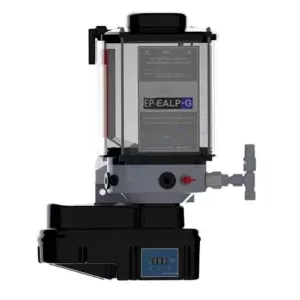
The EP-EALP-G series electric piston lubrication pump is a high-efficiency grease pump designed specifically for medium to large-scale equipment. It uses precision piston drive technology to deliver consistent grease output, maintaining accurate lubrication even in harsh conditions. Fully compatible with popular models like the Caterpillar 329D, it serves as a drop-in replacement for the German BEKA EP/EP-1 systems—matching perfectly in mounting interfaces, performance specs, and control logic.
Unlike traditional mechanical pumps, the EP-EALP-G uses an electric drive for intelligent operation, automatically adjusting lubrication cycles based on equipment workload. With a maximum output pressure of 350 bar and grease delivery up to 8–10 meters, it’s ideal for multi-point lubrication in agricultural machinery, construction equipment, mining vehicles, and large-scale manufacturing lines.
In Europe and North America, automatic electric piston pumps are fast becoming the go-to choice for OEMs looking to boost reliability and cut maintenance costs. Real-world data shows that equipment fitted with automated lubrication extends service intervals by over 30%, reduces failure rates by more than 25%, and saves up to 15% on grease consumption.
Product Features & Benefits
Built with a high-strength alloy pump core and precision-machined piston assembly, the EP-EALP-G stays rock-solid under continuous high pressure. Its dedicated drive motor ensures every lubrication cycle is spot-on, while the electronic timer allows adjustable intervals from 5 to 180 minutes—eliminating human error.
- Precise and Uniform Delivery: Piston-driven flow stays constant, avoiding the pulsation common in gear pumps.
- Extended Component Life: Timed, metered grease application cuts wear on bearings and joints, increasing part life by over 25%.
- Energy and Eco-Friendly: Optimized delivery improves grease efficiency by 10–15%, reducing waste.
- Smart Monitoring: Optional level sensors and pressure alarms provide real-time system status for uninterrupted operation.
- Low Maintenance: Modular design means pump cores or seals can be swapped in under 10 minutes with basic tools.
These strengths make the EP-EALP-G perfect for both standalone retrofits and OEM integration, delivering complete piston pumps lubrication solutions.
Working Principle
The EP-EALP-G operates on an eccentric-driven piston mechanism. When the motor runs, the eccentric cam drives the piston in a reciprocating motion, forcing grease through check valves into the distribution lines. Each cycle delivers a fixed volume at constant pressure, ensuring every lube point gets the exact same amount.
A built-in check valve system prevents backflow and air ingress, enhancing overall stability. The motor carries an IP65 rating, standing up to heat, dust, and vibration. The control system supports external PLC integration or standalone controllers for synchronized multi-point lubrication. Low-level alarms trigger when grease drops below 20%, and pressure sensors flag any outlet anomalies in real time.
Fully modular in design, the pump core, reservoir, motor, and control module can be replaced or upgraded individually. Standard models come with 2L, 4L, or 6L reservoirs and 1–6 outlets, easily tailored to different equipment sizes.
With its rugged build and high-precision drive, the EP-EALP-G series has earned trust worldwide as a reliable lubrication partner for OEMs and equipment operators alike.
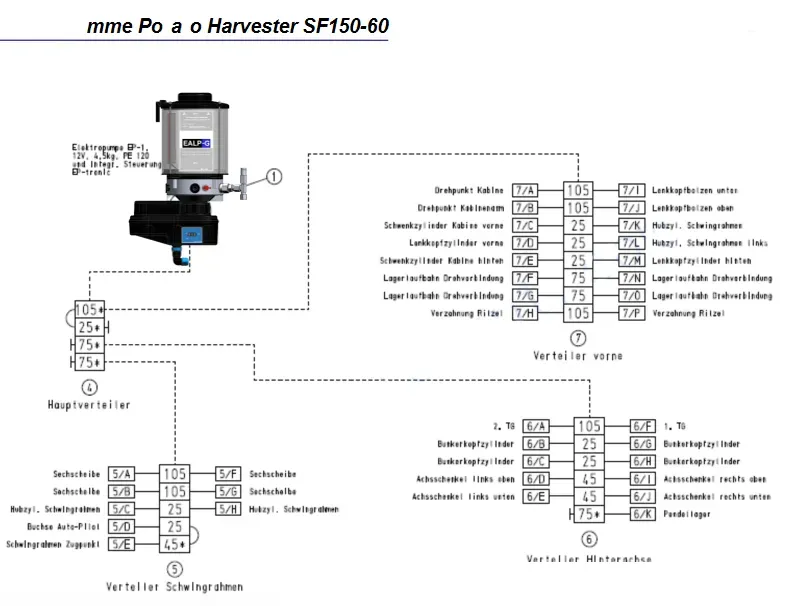
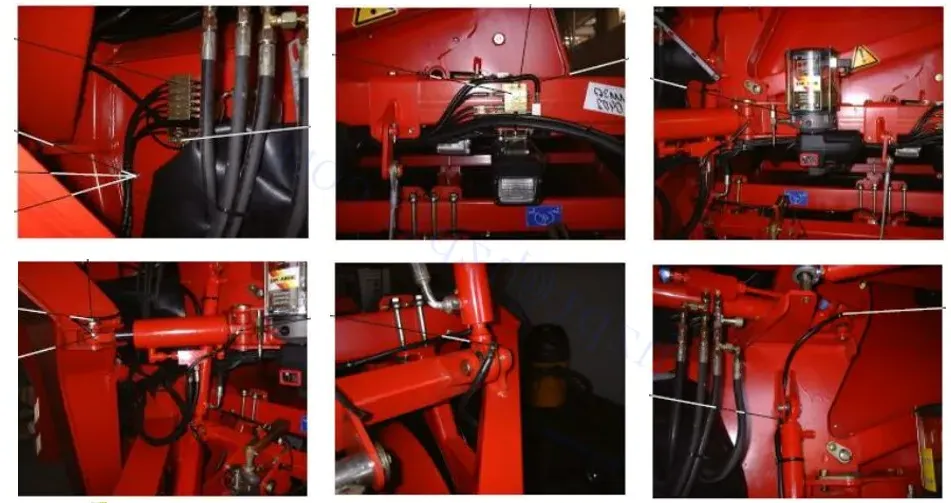
Applications & Case Studies
The EP-EALP-G Series electric piston lubrication pumps are designed for versatile use across a wide range of heavy-duty and precision machinery. They deliver consistent lubrication under high pressure, providing reliable performance even in demanding field conditions.
Construction and Earth-Moving Equipment
The piston pumps for heavy machinery perform exceptionally well on models such as CAT 329D excavators, 950G wheel loaders, Volvo EC series, and Komatsu PC equipment. With a maximum discharge pressure of 350 bar, the system ensures steady grease flow over long distances (up to 10 meters). Field data shows that machines equipped with EP-EALP-G systems extend their service intervals by an average of 28 percent, while reducing component wear and downtime.
Agricultural and Feed Processing Equipment
In agricultural applications, the piston-type electric grease pump is ideal for balers, harvesters, feed mixers, and fertilizer spreaders. Its automatic drive system eliminates the need for manual lubrication and reduces engine idling time during maintenance. This technology has been proven to increase bearing life by 20 percent and reduce lubricant waste by 15 percent, making it a smart investment for fleet operators and OEM integrators alike.
High-End Manufacturing & Automation
For CNC machines, robotic arms, and conveyor systems, the industrial piston lubrication system delivers precise, clean, and pressure-stable grease dosing. Its modular ports and electric control interface make it easy to integrate into automated production lines or OEM control logic.
Customer Case Studies
In Europe and South America, several OEMs have successfully adopted EP-EALP-G pumps as a direct replacement for BEKA EP/EP-1 systems. Field tests over 1,500 operating hours demonstrated consistent grease delivery with zero leakage or blockage incidents. The pump’s compact housing allows flexible installation — on machine frames, side panels, or undercarriages — making it suitable for both retrofitting and new equipment builds.
Selection & Ordering Guide
Choosing the right piston grease pump model ensures optimal performance and cost efficiency.
Model Selection by Lubrication Points & Pressure
For systems with up to 20 lubrication points and a working pressure below 250 bar, the EP-EALP-G-2 is recommended. For larger systems requiring up to 60 lubrication outlets or longer delivery lines, the EP-EALP-G-6 provides stronger output (up to 350 bar) and higher flow rates.
Customizable Options
Available reservoir capacities range from 2 L to 8 L, with 1 to 6 outlets configurable based on equipment design. OEM clients often prefer the 4 L / 4-outlet combination for its balance of runtime and compactness.
Electrical and Control Options
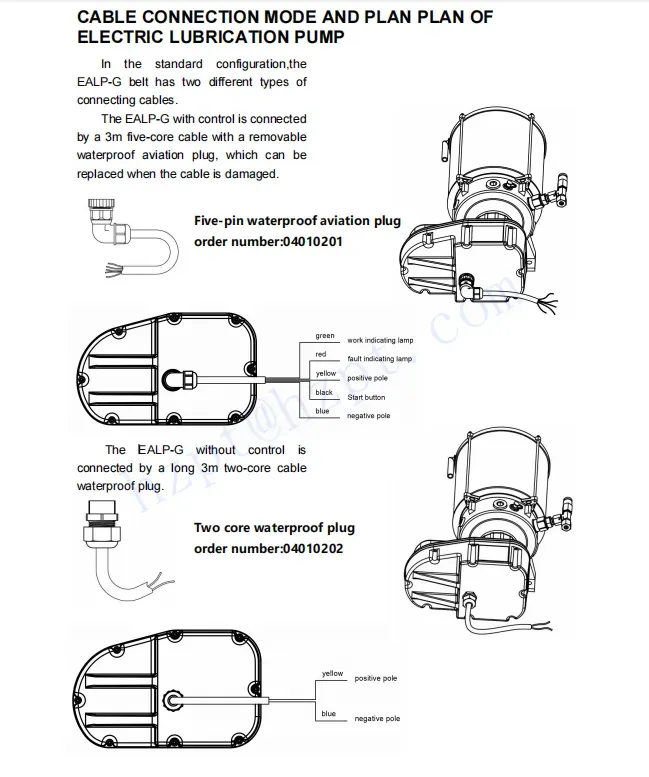
Supported voltages: 12 V DC / 24 V DC. Optional features include low-level sensor, pressure switch, and audible/visual alarm module. Control can be achieved through PLC signal, time relay, or manual trigger, ensuring compatibility with different regional standards and system architectures.
Packaging & Delivery
Each pump is 100 % function-tested before shipment and securely packed with anti-vibration foam and dust-sealed wrapping. Standard lead time: 7–15 days. OEM logo branding and private labeling are available. Minimum Order Quantity (MOQ): 5 units, with sample units ready for dispatch within 3 days.
Installation & Maintenance Guide
Proper installation and regular inspection guarantee the long-term reliability of your electric piston lubrication pump system.
Mounting Position & Orientation
Install the reservoir vertically on a stable surface, away from vibration and heat sources. Maintain airtight connections to prevent air ingress. The motor and control housing meet IP65 protection standards, suitable for outdoor or dusty environments.
Pre-Start Inspection
Before initial startup, verify voltage and polarity, confirm that the indicator light is on, and check that the grease level is above the minimum mark. It’s recommended to run the pump unloaded for 1–2 minutes to expel any trapped air from the system.
Grease Refilling & Low-Level Alarms
When the sensor signals low grease level (typically < 20 %), refill with NLGI #2 grade grease slowly to avoid trapped air bubbles. If system pressure exceeds 350 bar, check for blocked lines or distributor valves.
Routine Maintenance
Every three months, clean the suction filter and verify the safety-valve pressure setting. Replace piston seals or cartridges every 1,000 operating hours (or semi-annually). When equipment is idle for extended periods, seal outlets and clean the reservoir to prevent oxidation or grease hardening.
Following these maintenance steps will significantly extend the lifetime of your piston pump lubrication system, ensuring smooth, reliable operation and reduced service costs.
FAQ
Can this pump work with different types of grease or lubricants?
Yes. The pump is compatible with lubricants whose viscosity does not exceed NLGI-2 grade. Using clean, high-quality grease ensures stable flow and prevents clogging inside the piston system, keeping the lubrication process efficient.
What maintenance schedule is recommended for stable operation?
It is recommended to check the filter and safety valve every three months and replace the piston seal or cartridge every 1,000 working hours. Regular inspection and preventive maintenance help extend the system’s service life and minimize downtime.
Is the pump suitable for integration with OEM control systems?
Yes. The system supports both PLC signal and timer-based control, making it easy to integrate into OEM machinery or automatic lubrication systems without any complex modifications.
How can I troubleshoot low grease output or pressure drops?
Check if the grease level is below 20% and refill with NLGI #2 grease if needed. Make sure there are no blockages in the outlet lines and that the safety valve pressure is correctly set to around 300 bar. If the issue continues, inspect and replace the piston seal to restore optimal performance.